What a mini split tune-up covers in Mississippi

A local pro who services mini splits gets in touch about the tune-up.

Match me with a pro

What does a mini split tune-up actually include in Mississippi?

You want to know what you're actually paying for before a tech shows up. A mini split runs differently than a central system, so it makes sense to wonder if a tune-up means the same thing. With summers here pushing the unit hard for months, you'd rather know now what gets checked than find out later something got skipped.

It covers the indoor coil, the outdoor condenser, the filters, the drain line and the refrigerant charge

A technician cleans the indoor coil and the filters, checks the outdoor condenser coil and fan, clears the condensate drain line, and checks the refrigerant charge against what the system calls for. They also check the electrical connections and how the system cycles on and off. The drain line matters more here than in drier climates, since a mini split pulling moisture out of muggy air all summer can clog that line faster, and a clogged line backs up and drips inside. A dirty outdoor coil loses its ability to shed heat, which makes the compressor work harder on the hottest days. Catching that before July or August keeps the system running the way it's supposed to.

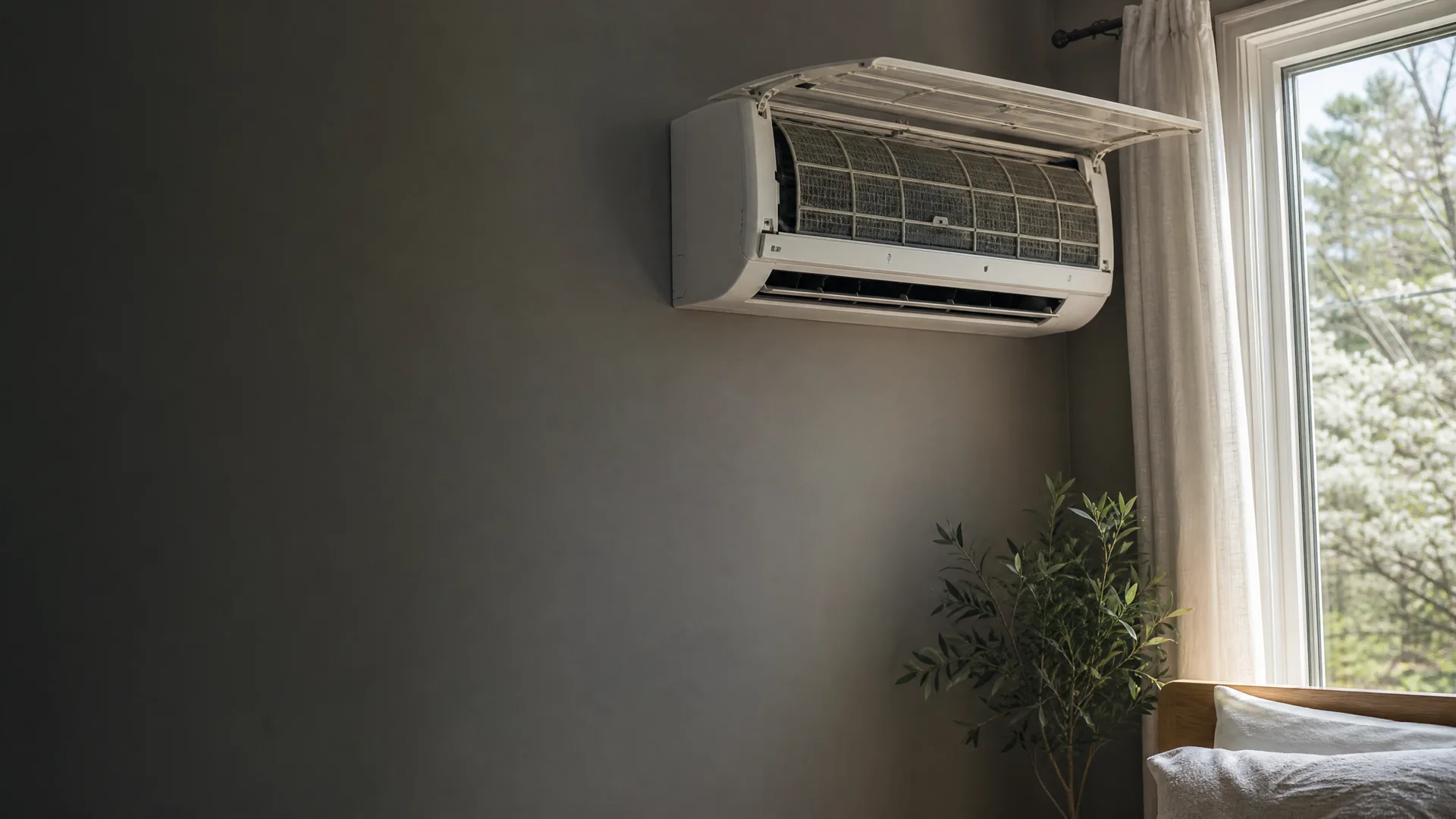
A wall-mounted mini-split air conditioner with its front cover open exposing the filters, on a gray interior wall beside a curtained window with green trees outside and a potted plant below.

Spring had barely started and your bedroom unit was already running most nights to pull the damp out of the air. You pop the front cover to vacuum the dust off the louvers, something you do every few months, and the filter screen stops you. It's grey and matted, the kind of dirty that happens fast once the air turns heavy outside. You hold it up to the window light and can barely see through the mesh. This is the same unit that'll run from April into October, and a clogged filter means it works harder to push out the same cool air, drawing more power to do it. You set it on the dresser to deal with properly, already thinking about whether it's cleaner than last spring or worse.


Cleaning It Yourself vs Having It Serviced

DIY cleaning

  • You can vacuum the louvers and wipe down the front cover yourself every few months.
  • Pulling the filter screens and rinsing them under the tap is something most homeowners can manage without a tech.
  • You won't reach the coil behind the filter or the blower wheel without taking the unit further apart than most owners should.
  • A rinse gets surface dust off, but it does nothing for the drain line or the refrigerant charge.
  • You have no way to check the outdoor unit's coil or confirm the system is pulling the right charge.

Professional tune-up

  • A contractor opens the unit further than the front cover, reaching the coil and blower wheel you can't get to.
  • The drain line gets flushed, which matters in Mississippi where the system runs most of the year pulling moisture out of the air.
  • The outdoor unit's coil gets checked and cleaned, something no amount of vacuuming the indoor louvers covers.
  • A tech can confirm the refrigerant charge is correct, which affects how hard the system has to work.
  • Instead of researching what's wrong and calling around for quotes, you get matched with a contractor who reaches out to you directly.
A white wall-mounted mini-split air conditioner on a beige interior wall, with a window at left showing trees and a wooden fence, and dark wood flooring below.

Clean and running right

This is what a serviced mini split looks like. The coil behind the filter is clear, the drain line moves condensate out the way it should, and the unit pulls the damp out of the air without running nonstop. Mississippi summers ask a lot of it. This is what keeps it able to answer.

A white wall-mounted mini-split air conditioner indoor unit with dark louvered vents, installed near the ceiling on a beige wall below white crown molding.

Dusty and overdue

That beige film on the casing is the first sign. Behind it, the coil is likely coated too, and a coated coil can't shed the heat it needs to. The unit still runs, but it works harder for less cooling, and it will struggle to keep up once it has to earn its keep again.

An older woman with gray hair in a cream knit sweater sits under a blanket on a sofa by a window, looking outside toward yellow-leaved trees, with a lamp, shelves and an armchair in the room behind her.
A gray-haired woman in a chunky knit sweater sits in an armchair with a blanket, looking out a window at yellow autumn foliage, with bookshelves and a potted plant behind her.
A gray-haired woman in a navy sweater sits in an armchair with a knit blanket beside a window, looking out at yellow autumn foliage, with a dining table and houseplant in the room behind her.
A gray-haired woman in a gray cowl-neck sweater sits in an armchair with a blanket, looking out a dark-framed window toward yellow autumn trees.

Matched to your mini split job

You already know what the filter screen and the louvers look like after a few months of Mississippi humidity, and you can handle that part yourself. The coil, the blower wheel, and the drain line are where a tune-up earns its keep, and getting to them means finding someone who actually works on mini splits, not just central systems. That search usually means a handful of calls, explaining the same thing to each shop, then sitting with quotes that don't line up because nobody looked at the same unit. With power priced the way it is here and your unit running hard through the damp months, a coil that's gone grimy or a drain line that's slow to clear costs you more the longer it sits. Handing off the search means you stop chasing contractors and start with someone matched to a mini split job in your area, who reaches out to you instead of the other way around. Your unit still needs the work. You just stop doing the legwork to find who does it.

Inside the unit, step by step

  • A tech pulls the cover and the filter screens off first, then gets to the coil underneath that you can't reach on your own.
  • The coil gets cleaned with a proper rinse or coil cleaner, since a film of dust there cuts how well the unit pulls moisture out of the air.
  • The blower wheel gets checked and cleaned, because a dirty wheel moves less air even when the fan sounds fine.
  • The drain line gets flushed so condensate keeps draining out instead of backing up into the unit or dripping where it shouldn't.
  • A tech checks the refrigerant charge against what the system calls for, since a mini split low on charge won't cool right no matter how clean it is.
  • The outdoor unit gets checked too, since a blocked or dirty outdoor coil makes the indoor half work harder than it should.

Once the cover and filter screens are off, the tech is looking at the coil, and this is the part doing the real work of pulling moisture out of your air. A thin layer of dust on that coil acts like insulation, so the system runs longer to do the same job. Cleaning it means a rinse or a coil cleaner made for it, not a wipe-down. Behind the coil sits the blower wheel, and this one surprises people. A mini split can sound fine, fan spinning, air coming out, while a caked blower wheel is moving a fraction of the air it should. Checking it by ear won't catch that. The drain line gets flushed next. Condensate has to leave the unit on its own, and a clogged line either backs up inside the unit or starts dripping somewhere in your house it shouldn't. From there the tech checks refrigerant charge against what your specific system calls for. A unit low on charge won't cool a Mississippi summer afternoon no matter how clean everything else is, and this is something you can't check yourself without gauges. Last is the outdoor unit, easy to forget because it sits outside and out of sight. A blocked or dirty outdoor coil makes the indoor half work harder for the same result, which shows up on your power bill before it shows up anywhere else.

A white wall-mounted mini-split air conditioner indoor unit with visible dust and staining along its lower vent, installed on a plain pale wall.
Before you get your mini split maintenance
A white wall-mounted mini-split indoor unit installed high on a gray interior wall, with a window at left and part of a light gray sofa with a dark cushion at lower right.
After you get your mini split maintenance
A single-story red brick house with a white door and three white-framed windows, fronted by an asphalt parking area with sun flare, surrounded by green deciduous trees under a bright hazy sky.

That dampness in the air isn't just a summer feeling, it's a number. Mississippi's summer dew point averages 70°F across June, July and August, according to NOAA climate data. At that level, the air is heavy enough that your mini split has to pull a lot more moisture out before the room feels dry, not just cool. A unit with a dirty coil or a slow drain line can't keep up with that load, so it runs longer and still leaves the room feeling damp. That's the air your mini split is working against every summer day here, not just on the hot ones.

NASA POWER T2MDEW county cells weighted by homes

A woman in a cream knit sweater sits in an armchair with her eyes closed near a window showing yellow autumn foliage, with a mug on a round wooden side table beside her.
A gray-haired man with a beard in a blue button-placket shirt reclines on a couch with his eyes closed, beside a sunlit window with a green plant.
A woman stands in the open doorway of a white stucco house holding the dark door, facing a man in a black cap and shirt seen from behind in the blurred foreground, with a potted flowering plant beside the entry.

So that's what a mini split tune-up covers

A tune-up means someone opens the unit up past the filter screens, cleans the coil, checks the drain line, and makes sure the blower wheel is moving air the way it should. That's the part you can't do standing on a step stool with a vacuum. You've got the filter screens and the louvers covered on your own, and that's worth doing every few months. The rest needs a tech with the right tools and the time to do it right.

You don't have to figure out which company does this well or sit on hold explaining your unit's quirks to three different dispatchers. Once you're matched with a contractor who works on mini splits in your part of Mississippi, they'll reach out to you directly. You've already read what the job involves. Next summer, when the dew point climbs again, your unit will be ready for it instead of straining to catch up.

Interior corner of a living room with a beige upholstered sofa and dark cushion in the foreground, a ceramic vase of leafy branches on a dark side table by a curtained window, a framed picture on the wall, and a wood-surround fireplace at right.
A dimly lit room with a dark gray wall holding a white wall-mounted mini-split air conditioner near the ceiling, with a sofa, table lamp, potted plant, and curtained window at left.

A mini split pro near you

Skip calling around to set up a mini split tune-up.

Step 1 of 3: Equipment