Tell us about the job
Takes about a minute. No obligation.
A mini-split compressor that quits in August did not fail on a single bad day. Homes in Pearl River County, MS run cooling about five months a year, from May through September. From May onward, the compressor starts and stops repeatedly through the hottest part of the year, and the contactor, the capacitor, and the refrigerant circuit all carry that load. A contractor diagnosing a failed unit in late summer checks those components against a system that has been running near its ceiling for months, not one that broke down fresh. The repair scope follows from what the opened unit shows, and parts that look borderline early in the season often do not survive it.
A mini-split repair here starts inside the unit, not behind the wall. Half the homes in Pearl River County, Mississippi were built in 1990 or earlier (2020-2024 ACS 5-year). Housing built well before ductless systems existed was wired and framed around whatever was running at the time, then changed as equipment changed. What a contractor pulls open at the indoor head or the condenser reflects that layered history: refrigerant lines run to fit an older layout, wiring spliced to meet a later standard, mounting surfaces that were not built for this bracket. The structural question is usually already answered. The repair question is what the opened equipment actually contains, and whether the parts it takes are still in production.
The Parts of a Mini-split a Contractor Checks First
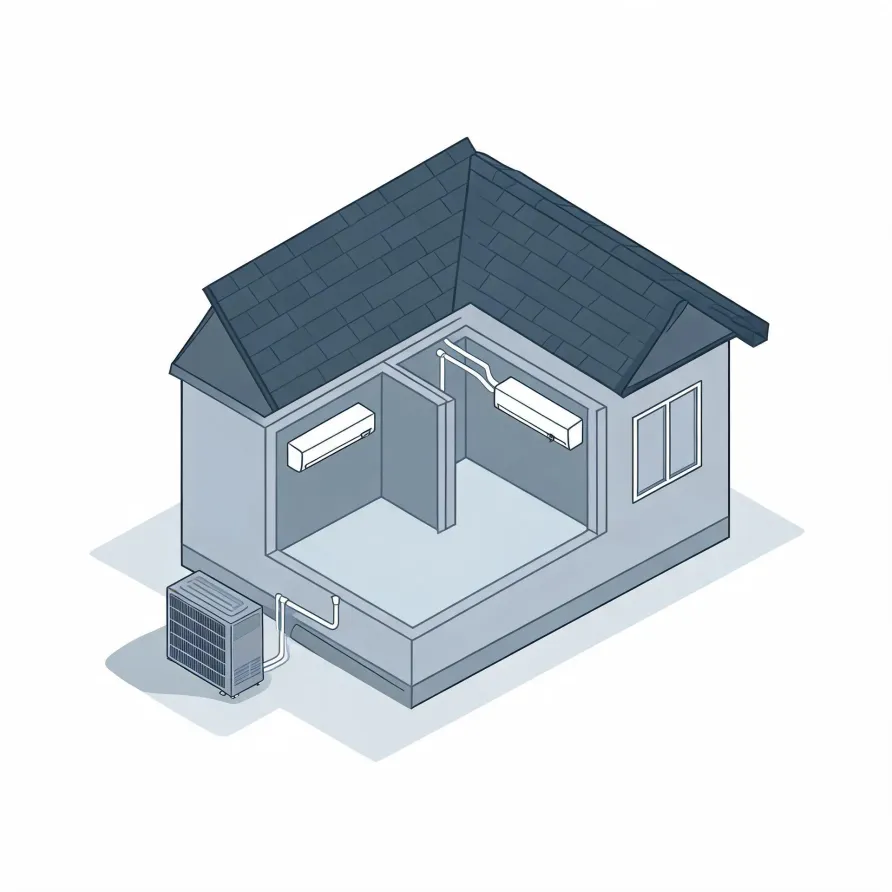
The indoor air handler mounts high on a wall inside the room and moves conditioned air directly into the space. When it acts up, the blower wheel, evaporator coil, or thermistor inside it are the first things a contractor opens it up to examine. The outdoor condenser unit sits outside the house and holds the compressor and condenser coil, both of which are common sources of failure when a system stops cooling or heating properly.
A refrigerant line set runs between the two units through a small opening in the wall, carrying the refrigerant that makes the whole system work. The condensate drain line exits the indoor unit and routes moisture outside. A contractor will check both the line set for leaks and the drain for blockages, since either can produce symptoms that look like something more serious.
The drawing beside this text shows the general layout of a mini-split system, and a licensed contractor determines which parts apply to the specific setup in your house.
Find a contractor in Pearl River CountyPearl River County, by the numbers
64 severe weather events were recorded in Pearl River County, Mississippi between 2015 and 2024.
NOAA National Centers for Environmental Information, Storm Events Database, bulk CSV export, events 2015-01-01 through 2024-12-31.Half the homes in Pearl River County, Mississippi were built in 1990 or earlier (2020-2024 ACS 5-year).
U.S. Census Bureau, 2020-2024 American Community Survey 5-Year EstimatesPearl River County, Mississippi holds 25,442 housing units (2020-2024 ACS 5-year).
U.S. Census Bureau, 2020-2024 American Community Survey 5-Year EstimatesOwners occupy 80.4% of the occupied homes in Pearl River County, Mississippi (2020-2024 ACS 5-year).
U.S. Census Bureau, 2020-2024 American Community Survey 5-Year EstimatesRules & Standards Behind Mini-Split Repair in Pearl River County, Mississippi1 sourced rules & standards
Licensing Rules for HVAC Repair in Pearl River County, Mississippi
Mississippi licenses residential HVAC work at every tier and at any price: a subcontractor of any tier doing heating, ventilation or air conditioning work on a residential construction or improvement project must be licensed by the State Board of Contractors no matter the dollar amount.
Severe Weather Events in Pearl River County, Year by Year
Storm activity puts real strain on heating and cooling equipment, and how hard a mini-split works over its life is partly a function of what the local climate throws at it. Pearl River County's weather record is part of what shapes repair demand here.
64 severe weather events, 2015–2024. Source: NOAA National Centers for Environmental Information, Storm Events Database.